


Sustainable value chain

Sustainable value chain

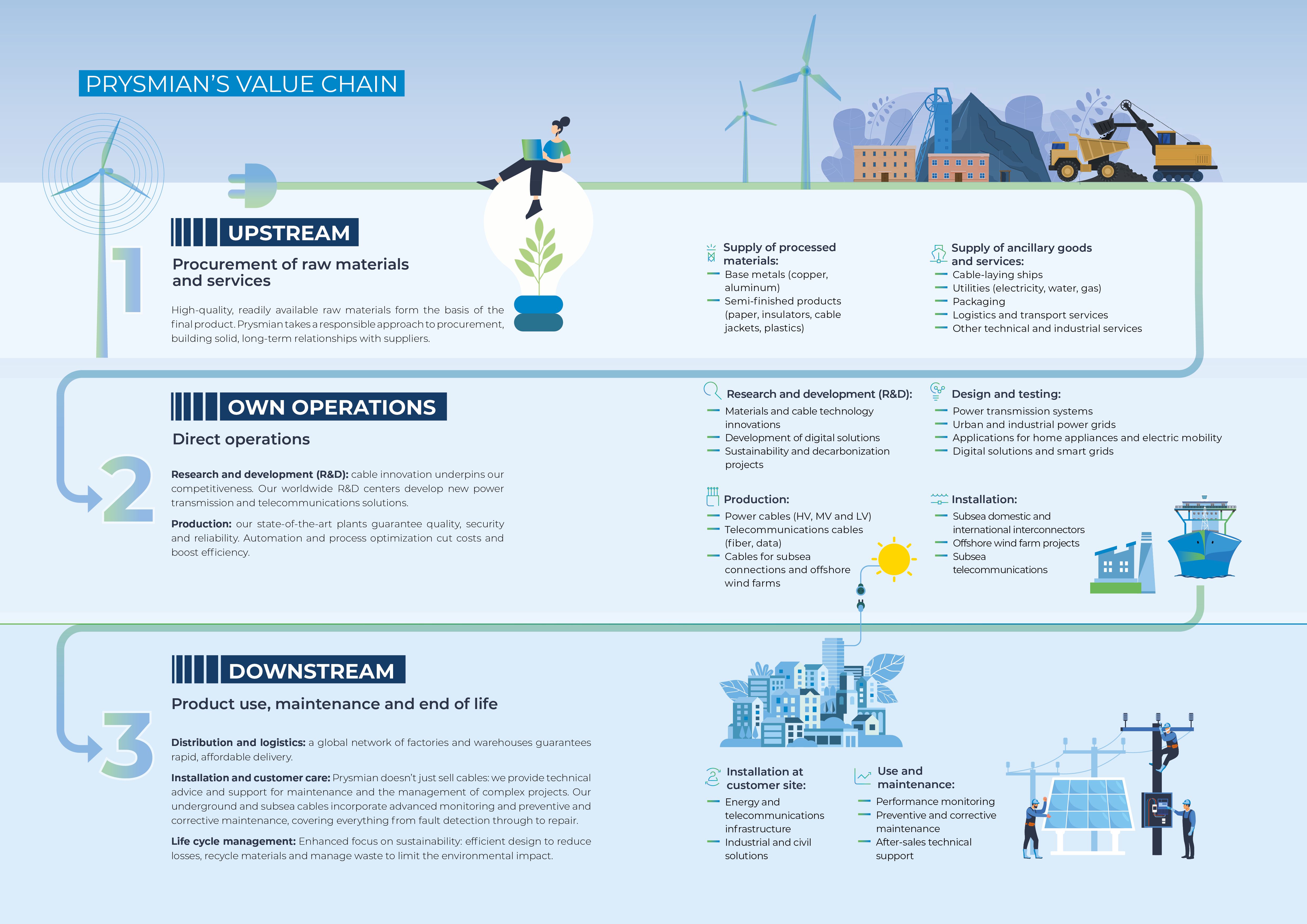
A sustainable value chain is critical for competitiveness and resilience. All of Prysmian's production processes take place with sustainability in mind. We anticipate our customers' needs and requirements by strengthening supplier relationships and focusing on the creation of value for them and all of our stakeholders.

The integration of financial, environmental and social sustainability underpins our operating model. Our technological and industrial leadership amplifies our positive impact on the community.
 

Distribution of value to stakeholders

The creation of value for all stakeholders is represented by the indicator “economic value generated and distributed”. This indicator, based on the re-aggregation of data from the audited financial statements, measures the overall economic wealth created by the Group. 

The economic value generated in 2025 amounted to €20,951 million, compared with €17,818 million in 2024. Most of this value, amounting to €19,657 million (€17,069 million in 2024) was redistributed to:


Prysmian's supply chain

Prysmian’s supply chain plays a decisive role in the business and the sustainability strategy, guaranteeing stable supplies and securing suppliers that meet the Group’s ESG requirements under long-term partnerships. The company ensures respect for workers’ rights, contributes to cutting Scope 3 GHG emissions and aims to deliver service excellence, strengthening its commitment to an ethical and responsible supply chain, in line with its participation in the Copper Mark Initiative.

In 2025, the expansion of the Group's value chain, including the full-year contribution of Encore Wire following its acquisition in 2024, led to a significant increase in the relevance of upstream Scope 3 emissions within the overall greenhouse gas footprint. As a result, particular attention is placed on Scope 3 Category 1 (Purchased Goods and Services), which represents one of the most material sources of upstream emissions. To provide a meaningful assessment of performance over time, the Group monitors a normalized emissions intensity indicator related to copper procurement. The indicator is calculated by dividing the greenhouse gas emissions (tCO₂e) associated with copper purchases by the corresponding quantity of copper purchased (tonnes).

The calculation covers the main categories of purchased copper, including copper cathodes, rods, semifinished products and scrap. Purchased quantities were multiplied by the relevant emission factors sourced from the Ecoinvent database to estimate the associated greenhouse gas emissions.

For comparability purposes, the year-on-year analysis has been performed on a like-for-like perimeter basis. Accordingly, both the 2024 and 2025 indicators include 12 months of activity data for Prysmian and Encore Wire. This differs from the methodology applied in the previous reporting cycle, where Encore Wire's contribution was included only for the six-month period following its acquisition. Consequently, the 2024 baseline has been recalculated to reflect the updated reporting perimeter and ensure a consistent comparison with 2025 performance. Based on this like-for-like approach, the emissions intensity indicator decreased by 6% compared with the recalculated 2024 baseline.


Purchased amount (tonnes)


Material 2024 2025
Copper - cathode 42.335 12.2888
Copper - rod 44.4761 539.371
Copper - semis 92.067 72.661
Copper - scrap - 41.527
Total 579.164 776.448

Total emissions (tCO2e)


Material 2024 2025
Copper - cathode 291.501 666.270
Copper - rod 2.700.191 3.230.856
Copper - semis 637.264 492.149
Copper - scrap - 71.314
Total 3.556.956 4.460.590
KPI (CO2e/purchased amount) 6,14 5,74

A customer-centric approach

Prysmian puts customers at the heart of what we do, from design through to delivery, continuously monitoring satisfaction through surveys, interviews and integrated digital systems with specific KPIs. The Customer Centricity team coordinates performance, complaints and quality, whilst business units and commercial teams lead feedback-based innovation and engagement. Thanks to our international presence and digital tools such as the Customer Portal / B2B Program, the Group is able to accelerate time to market, improve supply chain flexibility and build lasting customer relationships based on trust, harnessing customer engagement to drive innovation.